Couperose and vascular laser
Angiomas or ruby spots
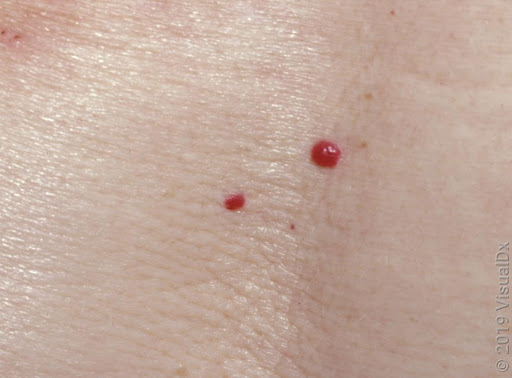
Angiomas, also known as senile angiomas, ruby spots or capillary haemangiomas, are benign vascular tumours that can have a significant aesthetic impact.
They are made up of small dilated vessels that appear on the skin, ranging in size from 1 millimetre to 5 or 6 millimetres. Larger ones can bleed easily, especially when rubbed or in contact with clothing.

Frequently asked questions
Click on the question to expand the answer
These “red moles” appear in both men and women from adolescence onwards, although they are more common from the age of 30 or 40. From this time onwards, they increase in number and size as the years go by. The exact cause is unknown, although there seems to be an associated hormonal component (which is why they appear more markedly during pregnancy), although they are also associated with other diseases such as POEMS syndrome.
The diagnosis of skin lesions should be made by a dermatologist. Angiomas can be easily diagnosed by inspection of the skin, although dermoscopy may be used in doubtful cases. A biopsy is rarely required to confirm the diagnosis.
Treatment of angiomas is not essential, although large lesions that bleed recurrently or are located in rubbing areas may need to be excised or removed. There are different methods including surgery, electrosurgery (using an electric scalpel), ablative lasers such as CO2, pulsed bleaching laser, pulsed light, or 1064nm vascular laser. Lasers and light devices are often associated with a better aesthetic result.
A single session is usually necessary to achieve the removal of most angiomas. Patients with multiple lesions or very small angiomas may require multiple sessions. As these are lesions that will appear over time, further sessions are usually recommended after months or years.
Depending on the technique selected to remove angiomas, we may experience more or less discomfort during the procedure. The treatment is usually performed without topical or local anaesthesia, although it is advisable for large lesions. The procedure is usually very well tolerated.
It is recommended to avoid sun exposure in the weeks before and after treatment to minimise the risk of post-inflammatory hyperpigmentation. It may be necessary to apply an antiseptic or repair creams or ointments after the procedure, and daily hygiene with soap and water to keep the treated area clean.
Book an appointment
You can make an appointment by phone, via email, or by filling in this form.
